
Paragon Insights
Managing 600 Fire Doors: How Do You Keep Track of Everything?
Managing a handful of fire doors is one thing. Managing 600 across multiple buildings is completely different.
· Paragon Group NW
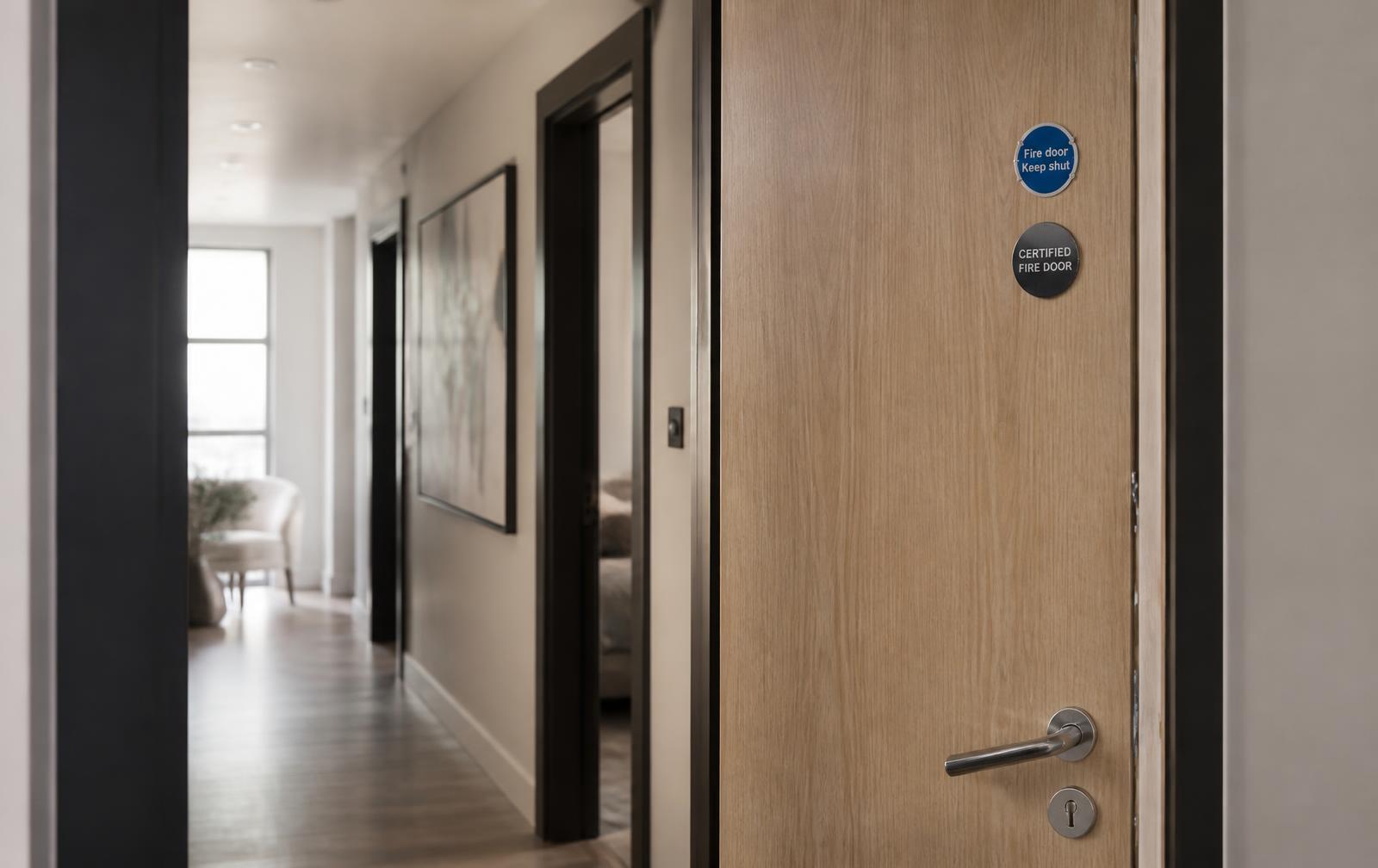
Once you get to that scale, carrying out the inspection is only part of the job. You need to know where every door is, when it was last inspected, whether it passed, what issues were found, whether remedial work has been completed and have the evidence to support it.
That’s exactly why we’ve invested in building our own digital inspection system at Paragon.
We wanted to make the process simpler for our engineers, but more importantly, give our clients a much clearer picture of what’s happening across their buildings.
Start with knowing exactly what you’re managing
Before you can manage hundreds of fire doors properly, you need a clear record of what is actually there.
Within our system, doors are organised by site and building, with each individual door having its own unique record.
Rather than working from one huge spreadsheet or trying to find information buried within previous reports, you can go from a site, into a building and then directly into the individual door you’re looking for.
That door record stays with the door.
So whether you’re looking at Door 14 or Door 514, you can quickly find the information and history attached to it.
600 doors shouldn’t mean searching through 600 records
This was one of the biggest things we wanted to solve.
If you’re responsible for several buildings, you don’t necessarily want to open individual inspection reports just to understand how you’re performing.
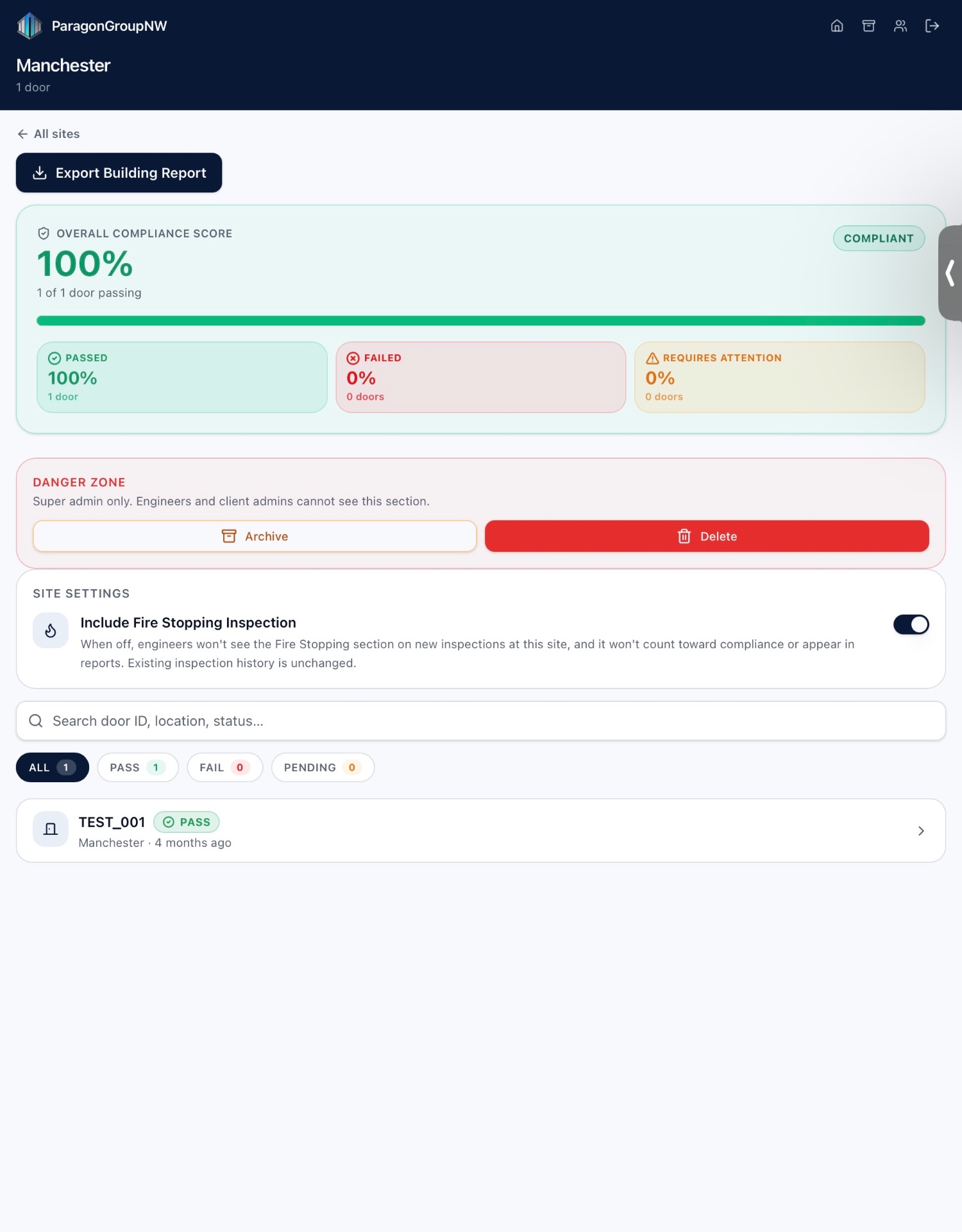
Our system gives an overview at building level, showing how many doors have passed, failed or are still pending inspection, alongside the percentages for each.
If a building has 200 doors and 35 currently have outstanding issues, you can see that immediately.
You can then drill down into the doors that need attention.
It turns a large amount of inspection data into something much easier to understand.
Every inspection follows the same process
Consistency becomes even more important when you’re dealing with hundreds of doors.
Our engineers work through the inspection digitally, following the required checks and recording the result against that specific door.
If an issue is identified, the engineer can record the reason for the failure, add further details and upload photographic evidence there and then.
That means the information isn’t sitting separately across someone’s phone, paperwork and an inspection report.
It’s attached to the door it relates to.
A failed inspection shouldn’t be the end of the story
This was another important part of how we designed the system.
Finding an issue is only useful if you can then keep track of what happens next.
Failed items remain visible so that engineers carrying out follow-up work can see what failed and why it failed, rather than starting the process again from scratch.
Remedial work can then be updated against the existing record, with further photographic evidence added where required.
So you begin to build a timeline:
Inspection → Issue identified → Remedial work → Evidence → Updated status
For the client, that means there is a much clearer trail showing what happened rather than simply having an old report saying that something failed.
Every door builds its own history
One feature we felt was particularly important was being able to look back.
Each door has its own maintenance and inspection history, so previous activity doesn’t disappear when another inspection takes place.
If somebody asks what happened with a particular door months later, you’re not searching through folders trying to find an old PDF.
You can go directly to the door and see its history.
When you’re managing 600 doors, that becomes a huge difference.
Photographic evidence stays with the inspection
Our engineers can also upload multiple photographs against individual sections of an inspection.
That gives both the engineer and client a visual record of what was found at the time, particularly where an issue has been identified.
When follow-up work takes place, further evidence can be recorded.
Again, the important part for us is that everything stays connected.
The door. The inspection. The issue. The photographs. The remedial work.
They’re not separate pieces of information that somebody has to join together afterwards.
Reporting without creating more admin
We still understand how important the final report is.
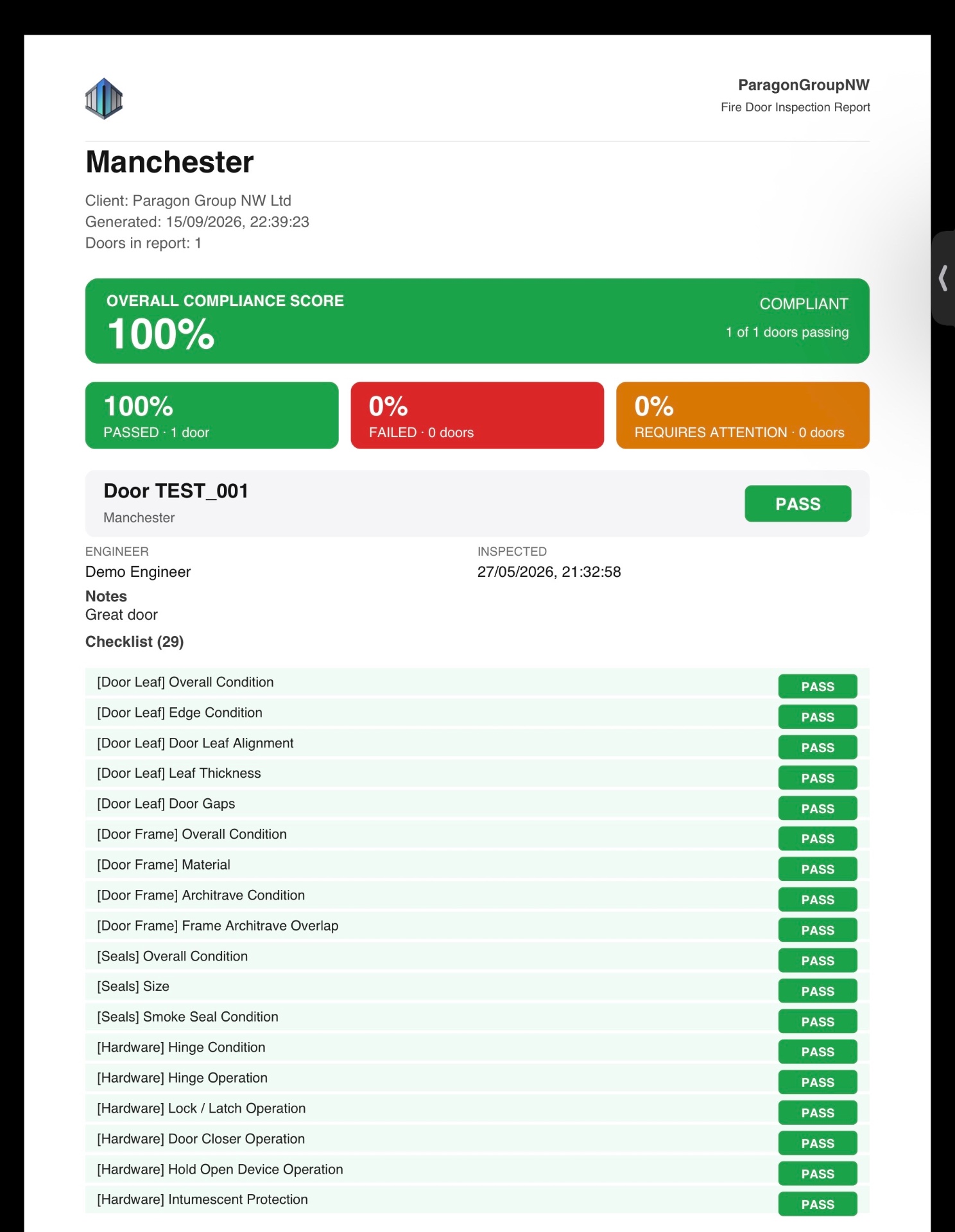
Buildings can have their latest inspection information brought together into a report, giving clients something that can be shared and retained where required.
But we don’t see the PDF as the only useful part of the process.
The real value is having the information available throughout the life of the door rather than producing a report and effectively starting again at the next inspection.
Built around how the work actually happens
We’ve developed our system around the way our engineers and clients actually work.
Engineers can be assigned to the buildings they’re working on, inspections can be completed on site, evidence can be uploaded at the point of inspection and outstanding issues can be followed through afterwards.
For clients managing multiple buildings, multiple sites or hundreds of doors, it creates one place to understand what’s happening across their portfolio.
And we’re continuing to develop it as we use it.
The idea behind it has always been fairly simple:
If you’re responsible for 600 fire doors, managing them shouldn’t mean managing 600 pieces of paperwork.
You should be able to see the bigger picture, find the individual door when you need it and have a clear history of what’s happened along the way.
That’s what we’ve built the Paragon system to do.